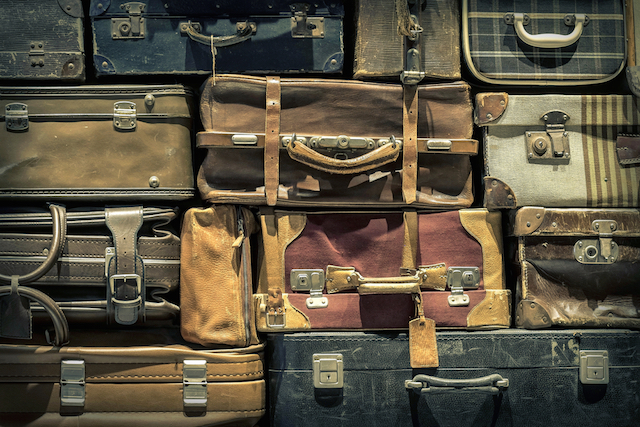
- What do you need to pack? — To know what kind and size of luggage you need, estimate the volume and weight of what you plan to carry in it. Or do it backwards: get a carry-on size main bag and limit your stuff to what will fit.
- What should you pack it in? — Put all your stuff in a main bag, a day bag and a hidden travel wallet or sewn-in pockets.
- How do you pack it? — You want to pack for volume efficiency, easy access to what you need most often, protection of delicate items and keeping your clothes wrinkle-free.
- What accessories can help protect, organize and move your stuff? — Some accessories are essential, although there are some commonly used ones that you really don’t need.
What do you need to pack?
Answer: the minimum clothing and gear to travel comfortably and efficiently — and that’s all!
So, what’s your minimum? It’s the clothing and gear that you can see yourself using every day, or at least every few days. And that depends on where you’re going, what the weather will be like, what activities you will do there and your personal style.

If you think you’ll use an item maybe once a month, leave it behind. The same goes for anything that “might come in handy.” It won’t, but you’ll regret hauling it all over the place in your luggage. Besides, many of these optional items — a jacket and tie or a fancy dress, perhaps — can be acquired during your travels if you really need them.
Some travelers assume they can get anything they need while traveling. It’s true for some items at some destinations. You can easily buy a cotton T-shirt in any town in the world. But there’s some stuff that is difficult or even impossible to find once you leave home or don’t have a delivery address for an online purchase. Try to find a well-sewn collared shirt made of “technical” fibers. Yes, you might find one after a time-wasting search, but there’s a good chance it won’t be the style, quality or price that you hoped for.
Think of it this way: anything you can buy in your local discount store, you can probably buy in any city in the world. Anything you can’t buy in your discount store, especially stuff that you can find only online, will be almost impossible to find while traveling abroad. That includes most technical clothing and compact, light-weight gear.
If you haven’t figured out what you truly need, please see other pages in the Prepare section of this site.
What should you pack it in?
Once you know what you will take on your trip, you need to decide how to carry it.
Will you have to to move your luggage yourself?
The necessity — or not — of moving and handling your luggage yourself will determine what kind is best for you.
The higher your style (and budget), the less it’s necessary to move your luggage. Some travelers only wheel their main bag from the baggage claim at the airport out to the taxi rank, then from the taxi in to the hotel lobby. But most independent travelers have to move their stuff further from time to time, maybe several blocks along streets, up and down stairs to the metro (subway) or in lodges or over other obstacles.
All but luxury travelers have to pull their bags off luggage belts and heave it into overhead bins or racks on aircraft, trains and buses.
Pro travelers account for the possibility of moving their luggage themselves and that’s why they prefer travel backpacks.
What’s your travel style?
Some travelers wouldn’t be caught dead lugging bags around on their backs or even off one shoulder — labor is for peasants. Others simply cannot carry their luggage due to physical limitations like a bad back or lack of muscle strength. Pro travelers, if physically able, almost always choose the most versatile bag, a travel backpack.
- entirely on what you take. You’ll have to pack it all in no more than three pieces — your main bag, your day bag and a hidden travel wallet or pocket.
You might wonder why it doesn’t much matter how long you plan to travel. That’s because, properly outfitted and geared-up, you should be able to travel indefinitely. The only issue over time is when clothing or gear wears out.
We divide your stuff in to three categories, from the most valuable to the least. Each type goes in a specific piece of luggage.
Vitals ➔ Travel wallet
If you lose absolutely everything else, you still need these:
- Passport
- Money (cards and/or emergency cash)
- Travel insurance policy, with contact information
- Life-sustaining drugs (for some people).
These should all get the utmost protection against theft, loss or damage, so they should go in your travel wallet. Other important but non-essential documents will go in there too, but don’t overload it.
Valuables ➔ Day bag
These items have high monetary value. (You should not travel with anything of unique sentimental value.) For most of us they’re mostly electronics: phone, tablet, computer, camera, eReader and so on. You should never put valuables in checked luggage or leave them where they could be stolen, although you’ll often leave some of them in a relatively secure room in your lodge when you’re out.
Regulars ➔ Main bag
Everything else goes in your main bag. These lower value items include your clothing, personal care products and other travel gear that does not have a high monetary value.
If you’re traveling in warm countries or during warm seasons, you should be able to pack everything in a carry-on size main bag and a day bag (what airlines call a “personal item”). For colder weather, or if you need to bring special gear from home, getting it all in a carry-on will likely require purchase of technical clothing and specialized compact gear to minimize bulk and weight.
Even if you have to get check-in size luggage, you still don’t want a huge bag. After all, independent travel means lots of movement between destinations. You’ll be lifting your luggage off airport carousels, loading it into luggage racks and heaving it up and down stairs. You’ll be carrying or dragging it through concourses and stations, along sidewalks, up and down curbs and over cobblestones or broken pavements. You’ll be packing and unpacking every few days on average.
Main travel bag
You use your main bag for moving the bulk of your stuff from place to place. The type of bag you need depends upon where you’re going, what the climate and culture will be like, and the style of travel you plan. To choose the best travel bag:
- Contents — What do you want to put inside it?
- Distance — Will you be carrying or pulling it for short or long distances?
- Ground — What surfaces or inclines you will be moving over?
- Weather — Will your bag be exposed to the elements?
- Handling — Will your bag be tossed, crushed and banged around?
- Security — Will your bag be left where it’s vulnerable to pilferage?
Get the best travel bag
Carry-on vs check-in size / Wheeled vs non-wheeled / More…
how to chooseDay bag
Your day bag is where you carry your valuables (but not your money, passport and other critical documents). It has two related, but distinct functions:
- In transit — When you move between destinations, all your most valuable stuff (with exceptions noted above) needs to be in your day bag.
- During daily outings — When you head out from your lodge, some of those in-transit valuables can be left behind in favor of an extra layer of clothing, an umbrella or other items required for your activities.
Your day bag should be the minimum size for these needs and comfortable to carry — it shouldn’t tire your shoulder, get in the way or require you to sweep it aside constantly. It must also maximize your defenses against weather, pickpockets, snatchers and your own forgetfulness.
Find the right day bag
Spacious / Organized / Secure / More…
how to chooseTravel wallet
Even in a “safe” city, you must protect your passport, financial instruments (credit cards, bank cards, large bank notes) and other vital documents. For this you need a travel wallet — a sewn-in closed pocket or suspended pouch worn under your clothes.
Select the best travel wallet
Hidden / Comfortable / Reliable
how to chooseLuggage accessories
- bullet
Consider luggage accessories
Security accessories / Packing accessories / What not to use
how to decideHow to pack
Consider carefully what you really need to take on your trip. And then figure out whether and how it will fit in the luggage you’ve selected. You will want to ensure that your electronics and other delicate items are adequately protected and that your clothing comes out of the bag ready to wear.
packing techniquesThe luggage we use
At How to Travel, we have our preferences on all aspects of travel. And on luggage it’s carry-on only — the famous one bag solution, best advocated by Doug Dyment on onebag.com.
Luggage is where you keep all your physical possessions during travel. It consists of three pieces: your main bag, your day bag and your travel wallet (where you hide your passport, money and other valuables).
These are our choices:
Carry-on sized travel backpack
Wheeled luggage doesn’t work for us, because our transportation isn’t always door-to-door — we have to walk with our luggage over many different surfaces and up and down stairs. Travel backpacks that can look like soft-sided suitcases when needed, are the way t o go.
o go.
Independent travelers often don’t know what airline they’ll take on their next flight, so what will the carry-on limit be? When you use budget airlines or, increasingly, conventional airlines in Europe, the Gulf and Asia, the old standard 56 X 36 X 23 cm (22 X 14 X 9 in) carry-on limits can be too big. It’s prudent to go with something slightly smaller. The luggage we’re now using is 51 X 33 X 23 cm (20 X 13 X 9 in).
This yields just 38.7 liters (2340 cu in) of volume, compared with 46.4 liters (2772 cu in) in the largest carry-on bags, although we confess to bloating the depth of our travel packs well beyond 23 cm (9 in). Yet, we managed well enough for seven months of warm climate travel (cold climates need more space for more layered clothing). In fact, we’re sure we can travel with less stuff next time.
Courier bag
You will need a “day bag” for your daily excursions and for keeping  your valuable and delicate stuff close when using transport.
Many travelers favor small backpacks, but we found that courier bags, although smaller, could carry all we needed. They did not need to be taken off just to grab a phone, a pen, a tissue or a water bottle. Slinging a backpack off one shoulder is pretty accessible, but also vulnerable to snatchers. A courier bag, worn across the body, was easier to keep secure in a packed subway car or on the street.
Courier bags are also more acceptable to airlines as a “personal item” than a loaded day pack.
Money belt
Unless you’re willing to have a large, flat hidden pocket sewn into all your (loose fitting) pants and shorts, the best secure stash for your passport, credit and ATM cards, banknotes and other valuable pap ers is a money belt, although we’re considering the hanging hidden pocket variety. The classic money belt is worn under your clothing, with a flat pouch in the small of your back. The silk one we used held all valuable papers for two of us (although we held cards and cash separately) and was so comfortable, it was easy to go all day in 38ºC (100ºF) and forget it was there.
Of course, muggers know about money belts, but it takes more time than grabbing your day bag and dummy wallet.
Accessories
We use packing cubes, stuff sacks, one plastic box, 4-letter combination locks and a cable lock. We don’t use any of the listed optional accessories above, except a rain cover made custom while on the road.
The keys to one bag travel
Traveling light is a science and an obsession. Throughout the site, How to Travel editors and members try to figure out how to do it better. But a quick summary would include:
- Leave it behind — If something isn’t absolutely essential, don’t pack it. What’s essential? We discuss that lots in the Prepare part of the site.
- Get zen about laundry — Traveling light means the fewest garments possible. Layering, yes. Color coordination, yes. But, unless you’re one of those people who can re-use underwear and socks, you’ll have to do laundry every 3-4 days. Sometimes you can get it done at your lodge or find a laundromat. But often enough, you’ll do it yourself in the sink. Make it a ritual and you’ll do fine.
- Wear technical clothing — Not only are “technical” clothes comfortable, they’re also low volume and light weight. Because of their fabrics, they’re easy to launder and quick to dry. From quality makers, they’re usually very well made and can survive constant wear and washing.
- Dump it — If you pack something and find you’re not using it, give it away, sell it or send it home. You don’t want to lug it around. The space and weight might then be used for something useful or for souvenirs.
Check under the Related Content topics for detailed information on each type of luggage. Traveling light or “one bag” is a constant theme throughout the site.