We divide all the stuff you travel with into “vitals,” “valuables,” and “regulars.” Travel wallets and hidden pockets protect the vitals.
When you travel, you carry all your material goods with you. The most precious items — your vitals — are the documents and money that you need to go anywhere and do anything.
Even if you’re going to a destination considered “safe,” the risk might slight, but it still exists. In Europe, we know that Rome and Athens are bad, but Barcelona is worse. Even chill Amsterdam is getting a rep for sly pickpockets. And, in Madrid, pickpockets prowl the Prado — the museum entrance fee must be worth the rich pickings. As you gawk at Goya, a carterista can be copping your cash and cards.
No matter where you are, you must actively protect your vitals.
You bear increased risk of theft if you’re obviously a foreigner. In poor countries, your luxury of travel is itself a definition of wealth, even if you are traveling “backpacker basic.” You still have more money and the time to spend it than most of the local population.
Thieves love foreigners. When you’re traveling between destinations and have your main bag with you, then the thief knows that absolutely everything you own is right there. If you’re on a daily excursion with just your day bag, the thief knows that your vitals and valuables might be in your room or hotel lock-up, but he assumes you have some portable wealth on your person.
There’s nothing to lose by taking simple precautions. It takes only a modest effort to maximize the security of your passport, money and other vital documents. Use a “travel wallet,” which can be a hidden pocket, money belt, belt pouch or other container hidden under your clothes. You will enjoy your travel more if you minimize worry about the safety of your key documents and money.
Where not to keep your valuables
There are so many ways to compromise the safety of your most valuable stuff. Some travelers are just too casual about it, trusting in the honesty of lodge staff and hostel roommates. Others, who carry their valuables with them, think that they’ll pay unwavering attention all day.
Where will secure your passport, your money, your other important documents?
- In your room, locked in your bag — You would never leave your valuables just lying on a table or in a drawer. It’s better to lock them in your main bag and then cable lock that bag to a piece of furniture or a pipe. That will deter opportunistic theft, but will slow down an accomplished thief only for a short time.
- In your room, locked in a safe or hostel locker — This is safer than your bag, but you don’t know how many hotel employees have security override access to that safe. Safety deposit boxes near Reception are more secure, but found only in better hotels. Hostel lockers are only as good as the locker latch and your lock. They provide modest deterrence.
- With you, buried deep inside your main bag — Is your bag going to be in your possession at all times? If you have to check it on a flight or put it in the bus cargo bay, you can’t leave your valuables in the bag. You’ll have to dig them out right then and there.
- With you, in an external pocket of your main bag — Luggage manufacturers make a big deal out of handy external pockets, even to the point of showing passports and tickets neatly tucked in them in their advertising images. But your valuables are even more vulnerable there than if buried inside the main compartment. A zipper lock is only a minor deterrent.
- With you, in your day bag — Your day bag is at greater risk of theft than your main bag.
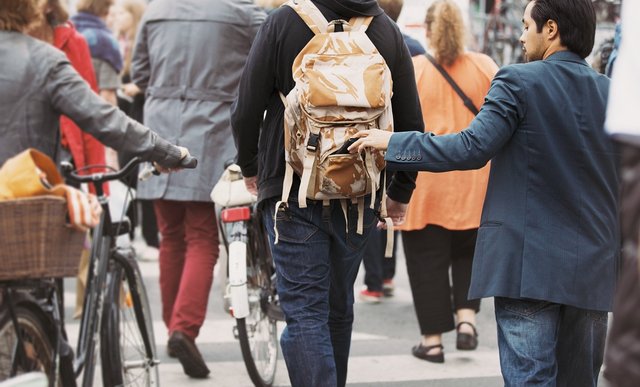
- Backpack type day bags are especially vulnerable to pickpockets, because they’re out of sight behind you. (See the photo at the top of the page.)
- Some attractions and sites don’t allow any bags, so you’ll have to retrieve your valuables and do something with them before you check-in your bag.
- It’s common to put your day bag down on a restaurant floor or shove it into an overhead bin on a train or bus. But, if you don’t pay constant attention to it or secure it to a chair, overhead bin rail or other object, it can be gone before you know it.
- You might even forget it in a bar or restaurant long enough for it to vanish.
- Someone can pick up your day bag from the other side of the airport baggage scanner while you’re still waiting to enter the body scanner.
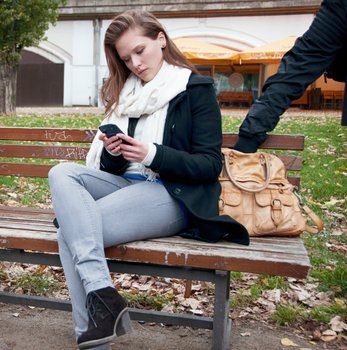
- With you, in external pockets — External pockets are the hunting ground of pickpockets. It’s also possible to lose items falling from unclosed pockets. Inside jacket pockets that are not closed by zippers or velcro are also at risk from skilled pickpockets.
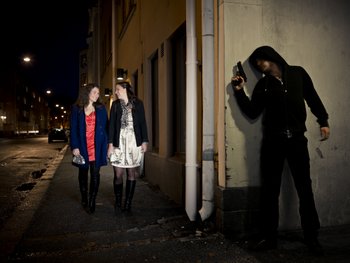 There is no 100% secure solution. You can make a judgement call as to whether your valuables are safer in your room or on your person. For example, if you’re going out at night to a known risky neighborhood, it might be wise to leave your loot in your room.
But, in most cases, the most secure place is on your person, under your clothing. We call such hiding places your “secure stash,” and your travel wallet is just one part of your secure stash strategy.
What do you have to protect?
Before you can figure out the best way to protect your valuables, you need to determine what needs protecting. While some are obvious, there’s a tendency to try to stuff too much into your secure stashes.
- Passport — You can’t cross a border without it and, depending you your nationality, it has resale value for thieves. You may be asked for your passport by a police officer or even the guy renting out headsets at a tourist site. For the former, keep a color photocopy of your passport ID page and (if possible) your visa and/or entry stamp. For the latter, any photo ID will do, including a driver’s license.
- ATM (cashpoint) and credit cards — Unless you plan to use one, keep them buried.
- Cash — Only keep handy the cash you think you’ll use during the day. Make it a generous amount, so that you don’t have to dig around to get more from your stash. All your surplus, especially large hard currency notes, should be hidden away.
- Printed tickets — Most airlines don’t print tickets anymore, but some do, so you’ll need to protect the ticket or print-out. Rail and bus tickets are almost always printed — the monetary value of the ticket might be modest (or not, in the case of rail passes), but your plans could be wrecked if your transportation is delayed or doesn’t happen at all.
- Vaccination book — This thing has no monetary value and might never be used, but it is absolutely impossible to replace if you lose it.
- Letter of invitation or booking — If you’re going to one of those countries that will admit you only if you have a letter of invitation or other official document to enter, keep that hard copy safe.
Other documents (prescriptions, driver’s license, hostel membership card…) are optional, but you shouldn’t bloat your secure stash. Some travelers try to stuff their mobile phones in their travel wallet, but this is wrong. Even if it fits, it will make the wallet too bulky. Besides, you can’t use the phone if it’s stashed.
Layer security of your “essentials”
To mitigate the risk of loss, you don’t want to “have all your eggs in one basket.” Spread your valuables and spread the risk — divide your valuables into 3 separate stashes.
 Dummy wallet — This is the wallet or clip you pull out when you’re paying in the market or on the street. It has only the money you need for the day in it. It helps if it’s also got a couple of expired credit cards, library card etc. so that it looks like your main wallet. A mugger in a a hurry will take it and go.
- Travel wallet — This is your money belt, hanging pocket or a hidden pocket inside your clothing that is big enough to hold your passport, large bank notes and your main ATM (cashpoint) card and credit card. If you plan to use one of your plastic cards that day, do not keep it in this stash, since you don’t want to be fishing around under your clothes while in public view.
- Deep stash — This is your emergency stash, in case your main stash is somehow lost or stolen. It contains a few USD 100 or EUR 500 notes, a copy of your passport ID page and your backup credit card (if you have one).
- Traveling with a companion — If there are two of you, it’s a bad idea for one of you to carry all the valuables for both, even though it’s easy to get all your valuables in to a single travel wallet. Splitting the risk is always best.
Types of travel wallet
Hidden pocket
A hidden pocket may be sewn into your pants or jacket by the manufacturer, or you can add them yourself. Making them yourself (or having them done) is a very cheap way to keep safe, but make sure that the stitching is absolutely excellent and the closing (either zipper or velcro) is secure. You don’t want your valuables falling out of a busted seam or even the entire pocket falling off.
The challenge is to place the pocket where it won’t bulge and be noticed. Forget putting them in skinny hipster pants. They’ll also sag in a shirt, once loaded with your stuff. A jacket is good, but don’t take the jacket off and leave it on the back of your chair at the bar.
Pants that are loose enough to hide the bulge are best. Keep in mind that you’ll have to have a pocket installed on every pair of pants or otherwise be sure to have a hidden pocket in whatever clothing combination you’re wearing every day.
Money belt
The classic money belt is worn around your waist, with the pouch hanging on the lower back. It’s under the shirt and tucked down the waist of your lower garment. If worn properly, it’s completely undetectable. Experienced muggers know about money belts, but it takes a little time and bother to establish that you’re wearing one and then getting it off.
If you’re concerned about safety in a hostel room, while camping in the open or similar situation where anything not on you is insecure, you can wear a money belt to bed.
Belt pouch
This variant on the money belt is pouch with loops that you string on your belt. Obviously, you need to wear a belt at all times if this is your only secure stash. Some users find them more comfortable than a money belt, although you have to wear loose fitting pants if the loaded pouch is not going to show a visible bulge against your thigh.
Regular belt with hidden compartment
These belts, for holding your pants up, have a zippered section on the inside where banknotes can be folded as secured. They’re good as a secondary stash, since passports and other bulky stuff won’t fit. Unfortunately, ATM and credit cards won’t fit in most of them either.
Not recommended
- Neck pouch — This is a pocket, like a money belt or belt pouch, but it hangs by a cord around your neck. They tend to get in the way, move too much and can be sweaty. The cord is often visible, becoming a target for snatchers. While the cord is fairly string, thieves mounted on motorbikes or lunging out of car windows rip the pouch right off, leaving a nasty burn on the victim’s neck.
- Bra pouch — These are too small for a main stash, but may suffice as a secondary stash as long as the wearer finds the pouch comfortable.
- Ankle pouch — A mugger won’t likely find this stash, but you can’t wear it with shorts. If you’re going to wear shorts, you’ll need a second travel wallet. Users also report that velcro grips weakens, the pouch tends to slide down the leg, there is sometimes uncomfortable abrasion and vulnerability to sweat.
How to evaluate a travel wallet
Security
- Visibility — Can your wallet be seen? Does is show a bulge, strap or a cord?
- Attachment — You don’t want the wallet to move or even fall off. Is it securely attached by a buckle or velcro. If it’s a buckle, will it stay closed or is it vulnerable to popping open? Will any cinching straps slide loose? If it’s velcro, will it keep it’s integrity over the entire duration of your trip?
- RFID shielding — There’s more worry about crooks reading your RFID-enabled credit and ATM cards than actual incidents. Yet, the risk is not zero. RFID shielding adds nothing but cost to your secure stash.
Storage
- Dimensions and capacity — Can the travel wallet hold everything in our short list above. (The vaccination book has the largest dimensions. If you don’t have a vaccination book, your passport is largest.) Can banknotes lie flat or to they have to be folded? On the other hand, the wallet should be big enough, but not so big that it flops around and gets in the way. For a secondary stash, it’s best if it can hold some bank notes, a photocopy of your passport and at least one ATM or credit card.
- Protection from moisture — If you’re wearing the pocket or pouch next to your body, it will come into contact with your sweat. And there can be a lot if you’re spending time outside in a hot climate or are doing strenuous activities. You don’t want your passport or money to get damp, so is there a moisture-resistant lining in the wallet? (In a pinch, a ziploc bag will do.)
Comfort
- Sizing & adjustment — Is the wallet one-size-fits-all or does it have straps that may not fit a large person? Is the entire wallet small enough for a petite person?
- Position and movement — Is the wallet out of the way when you walk and sit? If not, it could slap against your body, get scrunched up against your skin. In some cases, the stash might abrade your skin.
- Fabric — Some fabrics are smooth against your skin, while others are grippy and rougher.
- Breathability — Does the material wick moisture and breathe or does sweat accumulate and become uncomfortable?
Build quality
- Sewing — All seams must be strong and attachment points of belts, hoops or straps must be reinforced.
- Buckles & clasps — Duraflex or similar strong plastic is best.
- Velcro — If velcro is used, it must be a premium quality to endure at least daily fastening and unfastening for the entire duration of your trip.
- Zippers — If there are zippers, are they easy to open and close? Do they pop open under stress? You can’t go wrong with “YKK” brand.